Thursday, June 15, 2023

Multiple cysts of thyroid

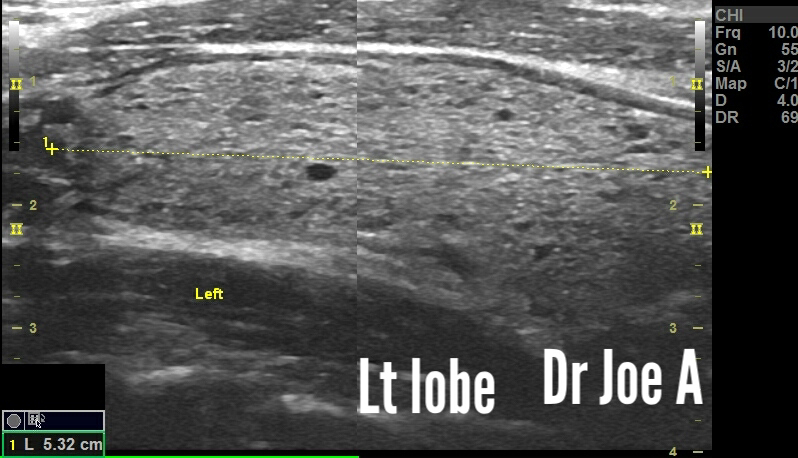
This middle aged female patient has multiple small cysts of the thyroid. Each of 3 to 4 mm size, totally 4 in number.
Incidental finding on thyroid sonography. 
Findings: 4 small cysts of the right lobe and isthmus of thyroid. No mural nodule seen. No vascular on color Doppler ultrasound. 

Final diagnosis: small colloid cysts of thyroid. Could be part of multinodular process. 

Thyroid cysts are usually benign (noncancerous).
* They are often asymptomatic and are found incidentally during a physical exam or imaging study.
* In some cases, thyroid cysts can cause symptoms such as neck pain, difficulty swallowing, or hoarseness.

Prognosis:

* The prognosis for multiple 4 mm cysts of the thyroid is generally good.
* Most cysts are benign and do not require treatment.
* In some cases, cysts may grow larger or cause symptoms.
* If this occurs, surgery may be necessary to remove the cyst.

Differential Diagnoses in this case include:
Colloid cyst: A colloid cyst is a benign cyst that is filled with a thick, gelatinous substance called colloid. Colloid cysts are the most common type of thyroid cyst.

* Thyroid solid nodule: A thyroid nodule is a solid mass that can develop in the thyroid gland. Thyroid nodules can be benign or malignant.

* Thyroiditis: Thyroiditis is an inflammation of the thyroid gland. Thyroiditis can cause the thyroid gland to become enlarged and tender. Increased vascularity on color Doppler ultrasound. 

* Goiter: A goiter is an enlarged thyroid gland. Goiters can be caused by a number of factors, including iodine deficiency, autoimmune disease. Multiple cysts, as in this case, may enlarge or increase in number causing a goiter. 

Management:

* Most thyroid cysts, such as these, do not require treatment.
* If a cyst is causing symptoms,  may needsurgery to remove it.
* FNAC if needed 
This can help determine if the cyst is benign or cancerous.

Some additional points to consider:

* Thyroid cysts are more common in women than men.
* The risk of developing thyroid cysts increases with age.
* Thyroid cysts are often associated with other conditions, such as Hashimoto's thyroiditis and Graves' disease.
* Thyroid cysts are usually benign, but they can sometimes be cancerous, especially in cases where mural nodules tend to form.

For more on this topic visit:


Tuesday, June 13, 2023

A huge serous cystadenoma


Huge cyst extending from the liver to the pelvis in a middle-aged female patient with a single small mural complex nodule of 5.7 cm and a single septum in the main cyst. 

Differential Diagnoses include:

* Hepatic cyst: A hepatic cyst is a fluid-filled sac that forms in the liver. It is the most common type of cyst in the liver, and it is usually benign.
* Cystadenoma: A cystadenoma is a benign tumor that forms in the liver. It is usually filled with fluid, but it can also contain solid tissue.
* Cystadenocarcinoma: A cystadenocarcinoma is a malignant tumor that forms in the liver. It is a rare type of tumor, and it is usually associated with other liver diseases, such as cirrhosis.

* Metastatic cancer: Metastatic cancer is cancer that has spread from another part of the body to the liver. The most common types of cancer that metastasize to the liver are breast cancer, lung cancer, and colorectal cancer.

Final diagnosis: serous cystadenoma vs serous cystadenocarcinoma 

What are various types of cystadenoma?
What are the ultrasound findings of huge cystadenomas:

Size: Huge cystadenomas are typically larger than 10 cm in diameter.

Shape: Huge cystadenomas are usually unilocular (single-chambered) cysts.

Content: Huge cystadenomas are typically filled with clear or mucinous fluid.

Wall: The wall of a huge cystadenoma is usually thin and smooth.

Internal echoes: Huge cystadenomas may contain internal echoes, which can be due to septations, papillary projections, or debris.

Vascularity: Huge cystadenomas are typically avascular (without blood flow).

The ultrasound findings of different types of cystadenomas can vary depending on the type of cystadenoma. For example, serous cystadenomas are typically unilocular and have a smooth wall, while mucinous cystadenomas are often multilocular and have a thick wall.

Here is a table that summarizes the ultrasound findings of different types of cystadenomas:


1. Serous cystadenoma | Unilocular, smooth wall, clear or slightly cloudy fluid.

2. Mucinous cystadenoma | Multilocular, thick wall, mucinous fluid.

3. Endometrioid cystadenoma | Solid or cystic, irregular wall, blood clots or debris.

4. Clear cell cystadenoma | Unilocular or multilocular, smooth or irregular wall, clear or cloudy fluid.

A definitive diagnosis can only be made with a biopsy or surgical removal of the mass.

Treatment: surgical removal 

Prognosis:

Prognosis for such a huge cystadenoma of the ovary is generally good, especially if the tumor is benign. Benign cystadenomas are slow-growing tumors that are not cancerous. Mucinous cystadenoma are usually filled with a thick, sticky fluid called mucin. Serous cystadenoma has clear serous fluid.  In most cases, benign cystadenomas can be removed surgically with no long-term complications.

Caution:
However, it is important to note that some cystadenomas can be malignant, or cancerous. Malignant cystadenomas are more likely to occur in women who are over the age of 50. They are also more likely to be large in size. If a cystadenoma is found to be malignant, the prognosis is less favorable. However, even with malignant cystadenomas, early diagnosis and treatment can improve the chances of survival.

Here are some of the factors that can affect the prognosis of a huge cystadenoma of the ovary:

The size of the tumor
The patient's age
The patient's overall health
The type of tumor (benign or malignant)
The stage of the tumor (how far it has spread)
The success of the surgery
The patient's response to treatment
If you have been diagnosed with a huge cystadenoma of the ovary, it is important to talk to your doctor about your prognosis. Your doctor can provide you with more information about your specific case and can help you develop a treatment plan.

Here are some additional information about cystadenomas:

Cystadenomas are the most common type of ovarian tumor.
They can occur in women of all ages, but they are most common in women between the ages of 50 and 60.
Cystadenomas can be either benign or malignant.
Benign cystadenomas are not cancerous and do not spread to other parts of the body.
Malignant cystadenomas are cancerous and can spread to other parts of the body, such as the liver, lungs, and bones.
The symptoms of a cystadenoma can vary depending on the size and location of the tumor.
Common symptoms include abdominal pain, bloating, and irregular menstrual periods.
If you have any of these symptoms, it is important to see a doctor right away.
Early diagnosis and treatment of a cystadenoma can improve the chances of a good outcome.


For more on this topic visit:

Saturday, June 3, 2023

Mirena IUD vs Copper T IUD

I compared the copper T IUD to the Mirena IUD as seen on sonography. 

Copper T IUD:


Mirena IUD: 

Mirena IUD is seen as thick with many lines on ultrasound imaging: 
because it is made up of a T-shaped plastic frame and a reservoir filled with a hormone called levonorgestrel. The T-shape of the frame and the multiple lines of the reservoir create a characteristic ultrasound appearance.

The T-shaped frame of the Mirena IUD is about 32 millimeters long and 3 millimeters thick. The reservoir is about 25 millimeters long and 5 millimeters thick. The reservoir contains about 52 milligrams of levonorgestrel, which is a hormone that is released into the uterus over the course of five years.

The levonorgestrel in the Mirena IUD thickens the cervical mucus, making it difficult for sperm to reach the egg. It also thins the lining of the uterus, making it less likely for an egg to implant.

Uses of Mirena IUD:
The Mirena IUD is a very effective form of birth control. It is more than 99% effective at preventing pregnancy. It is also a good option for women who have heavy menstrual bleeding, as it can reduce bleeding by up to 95%.

Differences between ultrasound appearances of Mirena IUD and copper T IUCD:

A. Mirena IUD:
    * The Mirena IUD is a T-shaped intrauterine device (IUD) that releases the hormone levonorgestrel.
    * On ultrasound, the Mirena IUD appears as a T-shaped structure with a small echogenic dot at the tip of each arm. Multiple linear echoes are seen around the Mirena IUD. 
    * The T-shaped structure may be surrounded by a hypoechoic halo, which represents the surrounding endometrial tissue.
    * The Mirena IUD may also cause posterior acoustic shadowing, which is a dark area behind the IUD that is caused by the sound waves being blocked by the IUD.


B. Copper T IUCD:
    * The copper T IUD is a T-shaped IUD that is coated with copper.
    * On ultrasound, the copper T IUD appears as a T-shaped structure with a smooth, uniform echogenicity. Single layered line of the body of copper T IUD seen. This is in my opinion the main difference between the two. 

Some additional points to consider:

1. Position: The Mirena IUD and copper T IUD should be in the fundus of the uterus. If the IUD is not in the fundus, it may be displaced or expelled.

2. Size: The Mirena IUD is larger than the copper T IUD. This may make it easier to visualize on ultrasound.

3. Shape: The copper T IUD has a T-shape, while the Mirena IUD has a straight shape. This may also make it easier to differentiate between the two IUDs on ultrasound.

More on comparison of Mirena IUD and copper T:

A. Mirena IUD:

* Mirena IUD is a hormonal IUD that releases the hormone levonorgestrel.
* It is inserted into the uterus by a healthcare provider.
* It is 99.9% effective at preventing pregnancy.
* It can last for up to 7 years.
* Mirena IUD may cause side effects such as irregular bleeding, spotting, or amenorrhea (absence of periods).
* It may also cause cramping, headaches, and nausea.
* Mirena IUD is a good option for women who are looking for a long-term, highly effective method of birth control that can also help to manage heavy menstrual bleeding.

B. Copper T IUCD:

* Copper T IUCD is a non-hormonal IUD that contains copper.
* It is inserted into the uterus by a healthcare provider.
* It is 99.2% effective at preventing pregnancy.
* It can last for up to 10 years.
* Copper T IUCD may cause side effects such as heavier bleeding, cramps, and spotting.
* It may also cause an increased risk of pelvic inflammatory disease (PID) in the first few weeks after insertion.
* Copper T IUCD is a good option for women who are looking for a long-term, highly effective method of birth control that does not contain hormones.

For more on this topic visit:

Thursday, June 1, 2023

A pretty large renal pelvic calculus

This patient has a pretty large left renal calculus lodged in the renal pelvis. But surprisingly, there are no obstructive changes.
ultrasound findings: a large calculus of 2 cms in the left kidney in the renal pelvis, with no hydronephrosis:

1. A focal, hyperechoic (bright) mass is seen in the left renal pelvis.
2. The calculus is associated with acoustic shadowing.
3. The renal pelvic calculus is approximately 2 cm in size.
4. The rest of the left kidney appears normal.
5.There is no hydronephrosis (dilation of the renal pelvis and calyces).
6. Color Doppler ultrasound shows twinkle artefact posteriorly. 

The prognosis for a large calculus in the left kidney is generally good. In some cases, the calculus will pass on its own within a few weeks or months. This is difficult here due to the large size. If the calculus does not pass, it can be removed surgically or with lithotripsy (a procedure that uses shock waves to break up the calculus).

The management of a large calculus in the left kidney will depend on the size of the calculus, the patient's symptoms, and the patient's overall health. In some cases, the patient may need to be monitored closely with ultrasound to ensure that the calculus does not cause any complications. In other cases, the patient may need to have the calculus removed surgically or with lithotripsy.

Some additional information about large calculi in the left kidney:

* Large calculi are more likely to cause pain than small calculi.
* Large calculi are also more likely to cause complications, such as hydronephrosis, infection, and bleeding.
* If a large calculus does not pass on its own, it is important to seek medical attention to prevent complications.


Wednesday, May 31, 2023

What's this band in the liver?

Whilst scanning the abdomen in this healthy young man, I found this echogenic vertical band passing through the liver. What could it be?
The ultrasound images are shown below:


Nothing abnormal. It's just the falciform ligament. 
What is that? We'll discuss in detail. 
What is unusual is that it is rather prominent in this case. 

Final diagnosis: a prominent falciform ligament in the liver. 

Located at the junction between the right and left lobes of liver. 

Why do I think this is the falciform ligament?
An echogenic vertical band between the right and left lobes of the liver in an adult male is most likely the falciform ligament. The falciform ligament is a fibrous band of tissue that separates the right and left lobes of the liver. It is made up of connective tissue and contains a small amount of fat. 

Significance:
The falciform ligament is a normal finding and does not usually cause any problems.

Can it be abnormal?
In some cases, an echogenic vertical band between the right and left lobes of the liver can be a sign of a more serious condition, such as a liver tumor or a liver abscess. However, these conditions are rare and would usually be accompanied by other symptoms, such as pain, fever, and jaundice.


Here are some additional details about the falciform ligament:

* It is a thin, fibrous band of tissue that extends from the diaphragm to the umbilicus.
* It separates the right and left lobes of the liver.
* It contains a small amount of fat.
* It is a normal finding and does not usually cause any problems.

More facts about the falciform ligament:
It is usually less than 1 cm thick.

In some cases, the falciform ligament may appear thickened or irregular. This may be due to a number of conditions, including:

* Liver disease, such as cirrhosis or hepatitis
* Inflammation of the falciform ligament (falciform ligamentitis)
* A tumor or abscess in the liver
* A blood clot in the falciform ligament (thrombus)

Here are some of the reasons why the falciform ligament may be prominent or visible as in this case:

1. Body habitus: The falciform ligament is more likely to be visible in thin patients. This is because the ligament is more superficial and easier to see.

2. Abnormalities in the liver: The falciform ligament may be more prominent if there is an abnormality in the liver, such as a cyst or tumor. This is because the ligament may be stretched or compressed by the abnormality.

3.Technique: The falciform ligament may be more visible if the ultrasound technician is using a high-frequency probe and is scanning in the right plane

If the falciform ligament appears thickened or irregular on ultrasound imaging,  it may be advisable to have additional tests, such as a CT scan or MRI, to determine the cause.

A word on another important ligament that may be visible in some cases: The ligament teres:
The ligamentum teres is a fibrous cord that is located in the free, inferior border of the falciform ligament. It is a remnant of the umbilical vein, which carried blood from the placenta to the fetus during pregnancy. The ligamentum teres courses along a fissure situated between the inferior surface of the right and left lobes of the liver. It can be seen on ultrasound as a thin, linear structure that runs parallel to the falciform ligament.

The ligamentum teres is not always visible on ultrasound. This is because it can be small and/or fatty. It is more likely to be visible in people who have had surgery on their abdomen, such as a cesarean section.

The ligamentum teres can be a useful landmark for radiologists and surgeons. It can be used to help identify the liver and its lobes, as well as the falciform ligament. It can also be used to guide needle biopsies of the liver.

Some additional details about the ligamentum teres:

* It is typically about 10-15 cm long.
* It is located in the free, inferior border of the falciform ligament.
* It courses along a fissure situated between the inferior surface of the right and left lobes of the liver.
* It is a remnant of the umbilical vein.
* It is not always visible on ultrasound.
* It can be a useful landmark for radiologists and surgeons.

For more visit:

Sunday, May 28, 2023

Normal carotid artery Doppler

Adult patient underwent carotid artery Doppler ultrasound. 
Intima media thickness:
Common carotid:

Vertebral arteries:

Vertebral arteries:
Flow red in both CCA and vertebral arteries: antegrade flow:

Common carotid spectral Doppler:
Mixed effect of both ECA and ICA:

ECA: higher PSV, lower diastolic flow:
External carotid 👆

Internal carotid: low resistance flow, higher diastolic flow: lower PSV:

IMT:
The normal intima-media thickness (IMT) of the common carotid artery is less than 0.8 mm in men and less than 0.7 mm in women. IMT is a measure of the thickness of the inner layer of the carotid artery, which is called the intima. An increase in IMT is a sign of atherosclerosis, a buildup of plaque in the carotid artery. 

Factors that can increase IMT:

* Age
* High blood pressure
* High cholesterol
* Smoking
* Diabetes
* Family history of heart disease


In some cases, an increased IMT may require treatment with surgery to remove plaque from the arteries.

More about IMT:

* IMT is a screening test, not a diagnostic test. If IMT is increased, it does not mean atherosclerosis. However, an increased IMT is a risk factor for atherosclerosis, and it can help identify people who are at increased risk of developing heart disease or stroke.
* IMT can change over time. If you have an increased IMT, it is important to have your IMT checked regularly to see if it is getting worse.

Normal spectral Doppler parameters:

Common carotid artery:
    * Peak systolic velocity (PSV): <125 cm/s
    * End diastolic velocity (EDV): <40 cm/s
    * Pulsatility index (PI): <2.0
Internal carotid artery:
    * PSV: 40-80 cm/s
    * EDV: 20-40 cm/s
    * PI: 1.0-2.0
External carotid artery:
    * PSV: 50-100 cm/s
    * EDV: 20-40 cm/s
    * PI: 1.5-2.5
Vertebral arteries:
    * PSV: 50-100 cm/s
    * EDV: 20-40 cm/s
    * PI: 1.5-2.5

Differences ECA and ICA:
The normal spectral Doppler waveform of the external carotid artery (ECA) and internal carotid artery (ICA) are different. The ECA has a higher resistance waveform with less diastolic flow than the ICA.

The ICA has a low resistance waveform with continuous forward diastolic flow. This is because the ICA supplies blood to the brain, which has a low resistance vascular bed. The ECA supplies blood to a variety of tissues, including the face, scalp, and neck, which have a higher vascular resistance.

Vertebral arteries:
The direction of flow in the normal vertebral and common carotid arteries on color Doppler ultrasound is antegrade, meaning that the blood is flowing towards the head. This is because the vertebral and common carotid arteries supply blood to the brain.

In some cases, the direction of flow in the vertebral and common carotid arteries may be reversed. This is called retrograde flow and it can be a sign of a problem, such as a stenosis or occlusion of an artery.

It is important to note that the direction of flow in the vertebral and common carotid arteries can be affected by a number of factors, such as the patient's position, the angle of the ultrasound beam, and the presence of atherosclerotic plaque. 

More details:

Vertebral arteries: The vertebral arteries are a pair of arteries that supply blood to the brainstem and cerebellum. The direction of flow in the vertebral arteries is always antegrade.
However, in some cases, the direction of flow in the vertbral artery may be reversed. This is called subclavian steal syndrome; and it occurs when there is a stenosis or occlusion of the subclavian artery. In subclavian steal syndrome, blood flows retrograde from the vertebral artery to the subclavian artery in order to supply blood to the arm.

Common carotid arteries: The common carotid arteries are a pair of arteries that supply blood to the head and neck. The direction of flow in the common carotid arteries is usually antegrade. 

For more on this topic visit:


Wednesday, May 24, 2023

Leopard 🐆 skin thyroid: what's that?

Middle aged male with symptoms of hypothyroidism. Ultrasound and color Doppler imaging was done which revealed:
Ultrasound images show a characteristic leopard 🐆 skin appearance of the thyroid with mild increase in flow on power Doppler ultrasound. 
The leopard skin appearance of the thyroid gland on ultrasound is a characteristic finding of Hashimoto's thyroiditis, an autoimmune disorder that causes inflammation and enlargement of the thyroid gland. The ultrasound appearance is due to the presence of multiple, small, hypoechoic foci (areas of decreased sound transmission) within the thyroid gland. These foci represent areas of lymphocytic infiltration, or the accumulation of white blood cells (lymphocytes) in the thyroid tissue.

Other differential diagnoses for the leopard skin appearance of the thyroid gland on ultrasound include:

1. Graves' disease: An autoimmune disorder that causes hyperthyroidism, or overactive thyroid function. Not likely here as symptoms are not present. Also color Doppler shows normal vascularity. 
2. Thyroiditis: Inflammation of the thyroid gland. Most likely, Hashimoto's thyroiditis in this case. 
3.Thyroid cancer: A malignant tumor of the thyroid gland. Not likely here. 

The ultrasound appearance of lymphocytic infiltration of the thyroid gland is variable and may not be specific for any particular disorder. In general, lymphocytic infiltration can cause the thyroid gland to appear enlarged, heterogeneous, and hypoechoic. However, the ultrasound appearance of lymphocytic infiltration may be normal in some cases.

Additional information about Hashimoto's thyroiditis:

1. Hashimoto's thyroiditis is the most common cause of hypothyroidism, or underactive thyroid function.
2 . The symptoms of Hashimoto's thyroiditis can vary from person to person and may include fatigue, weight gain, cold intolerance, dry skin, and hair loss.
3. Hashimoto's thyroiditis is treated with thyroid hormone replacement therapy.

The management and prognosis of lymphocytic infiltration of the thyroid gland depends on the underlying cause of the condition:

In the case of Hashimoto's thyroiditis, the condition is typically managed with thyroid hormone replacement therapy. This therapy helps to replace the thyroid hormone that is not being produced by the thyroid gland. With treatment, most people with Hashimoto's thyroiditis are able to live normal, healthy lives.

In some cases, lymphocytic infiltration of the thyroid gland may be a sign of thyroid cancer. If carcinoma thyroid is suspected, a biopsy of the thyroid gland will be performed to confirm the diagnosis. 

 
Important information about lymphocytic infiltration of the thyroid gland:

A. Lymphocytic infiltration of the thyroid gland is a common finding in people with Hashimoto's thyroiditis.
B. Lymphocytic infiltration of the thyroid gland may also be seen in people with thyroid cancer.
C.The presence of lymphocytic infiltration in the thyroid gland does not necessarily mean that there is a problem.

For more on this topic visit: